
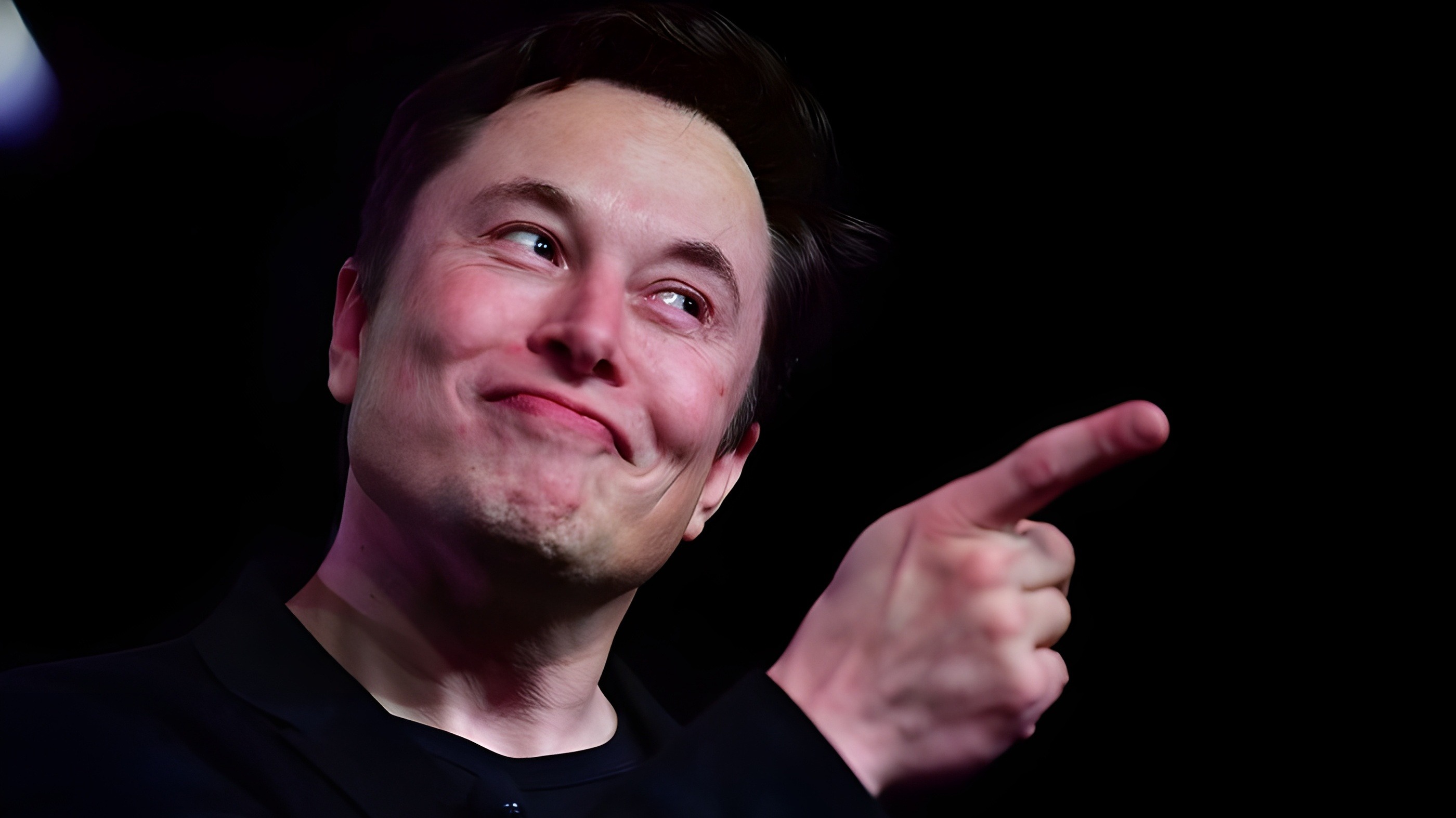
Elon Musk’s Thermodynamic Argument: Why AI Infrastructure Must Leave Earth
Views: 7
Elon Musk’s Thermodynamic Argument: Why AI Infrastructure Must Leave Earth – By Frederic Eger, Interplanetary.tv – Photo credit: AI generated – Video credit: NASA – Elon Musk recently claimed to JPMorgan CEO Jamie Dimon that artificial intelligence cannot physically survive on Earth, asserting we can achieve “probably somewhere around 1 terawatt per year of AI space compute from Earth, but we can do 1,000 terawatts or more from the Moon.” He then proposed using an electromagnetic railgun on the Moon to “shoot” AI data centers into deep space like projectiles. This is not engineering—it is PR theater from a narcissist billionaire who mistakes sci-fi fantasy for technical feasibility.
Elon Musk’s Non-Sensical Engineering Statements (2002–2026)
2002 – “Electric cars will be mainstream in 5 years” (Tesla founded; mainstream EV adoption took 20+ years)
2008 – “Tesla Roadster will have 500-mile range” (Actual range: 245 miles; later Model S: 400 miles)
2012 – “Hyperloop will operate at 700 mph in vacuum tubes” (No Hyperloop built; physics problems with vacuum tube passenger transport never solved)
2013 – “Tesla Gigafactory will produce 500,000 cars/year by 2017” (Reached 500k in 2020, 3 years late)
2015 – “Autopilot will be fully autonomous by 2017” (Still not fully autonomous in 2026; 9 years late)
2016 – “Tesla Semi will have 500-mile range with payload” (First delivery 2024; actual range with payload: ~300 miles)
2016 – “Rover car will drive underwater” (Never built; physics impossible without pressurized hull)
2017 – “Boring Company tunnels will replace highways by 2025” (Only 1.7-mile Las Vegas tunnel operational; no highway replacement)
2017 – “Starship will be operational by 2020” (First crewed orbital flight still not achieved in 2026; 6 years late)
2018 – “Tesla will produce 5,000 Model 3/week by Q2 2018” (Reached in Q3 2018; 3 months late, production chaos)
2018 – “Full Self-Driving will be ready by end of 2018” (Still not deployed in 2026; 8 years late)
2019 – “Neuralink will implant chips in humans by 2020” (First human implant 2024; 4 years late, limited functionality)
2019 – “We’ll have millions of Robotaxis on road by 2020” (No Robotaxi fleet in 2026; 6 years late)
2020 – “Tesla Battery Day: 50% cost reduction, 5x capacity” (Actual: 10-15% cost reduction; capacity unchanged)
2020 – “SpaceX will catch rocket booster with chopsticks by 2021” (First successful catch March 2025; 4 years late)
2021 – “Neuralink will cure paralysis in 2 years” (Still experimental in 2026; limited success)
2021 – “Twitter will be 90% bot-free by 2022” (Bot problem unchanged in 2026; 4 years late)
2022 – “I’ll sell all my houses, live in tiny box” (Still owns multiple properties; never moved)
2022 – “Tesla AI Day: Optimus robot will do everything by 2023” (Optimus still prototype in 2026; no commercial deployment)
2023 – “Starship will fly humans to Moon by 2024” (No crewed lunar flight planned before 2028; 4+ years late)
2023 – “Tesla will have million-mile battery by 2024” (No million-mile battery in 2026)
2024 – “X (Twitter) will have 1 billion users by 2025” (Still ~500M users in 2026; 500M short)
2024 – “Neuralink will have 10,000 patients by 2025” (Fewer than 100 implants in 2026; 99% short)
2025 – “SpaceX will launch 1,000 Starships per year by 2025” (Launched ~10 Starships in 2025; 99% short)
2025 – “Tesla will produce 20 million cars/year by 2030” (Produced ~1.8M in 2024; would need 11x increase)
2026 – “AI cannot survive on Earth; need 1,000 terawatts from Moon using railgun to fire data centers” (Engineering nonsense: electronics destroyed by acceleration, no destination, 1,000x energy claim impossible).
The What would you shoot them AT? Musk says “into deep space” but specifies no destination. Data centers must be WHERE—to compute something for users. If you’re firing them into vacuum, they’re useless. There is no “out there” needing computing power more than Earth.
The 1,000 terawatt claim is fantasy. Where does the energy come from on the Moon? Solar arrays work at Earth-equivalent efficiency (just no atmosphere). You’d need lunar mining, manufacturing, and construction infrastructure FIRST—that infrastructure requires MORE energy than the data centers would use. The math doesn’t work: you cannot get 1,000x more energy from the Moon.
The supply chain problem is backwards. You’d need to build the railgun ON the Moon first—mining lunar materials, manufacturing components, assembling—all requiring equipment sent from Earth. You’re not eliminating Earth supply chains; you’re creating a lunar one.
What Musk probably means: launch raw materials (lunar ore, which is solid) into space more easily, then build something ELSE there. But he conflates firing raw materials (plausible) with firing data centers (impossible).
Even if you could fire things: what’s the destination? A data center needs user connectivity. Moon-to-Earth latency is 1.3 seconds. No infrastructure exists in deep space to receive or use data centers.
Being listened to does not mean being correct. Wealth does not mean sanity. The Gossip Theory predicts: when attention becomes your reward, nonsense becomes your output. Talking non-sense for cheap popularity is really dangerous, jokes should remain private. And the actual question ends up being: “How much is enough?”
— Frederic Eger
About the Author
Frederic Eger (1975), trailblazing Israeli-Argentine-French journalist, author, and filmmaker, drives media innovation since 1998. He dives deep into science, technology, space, and geopolitics. With a BA in History from the Sorbonne and BA equivalent (professional program certificate) in Film & TV Production from UCLA, Frederic Eger belongs to the next-generation Zionist thinkers, unveiling books such as Albert Einstein: The Father of Federal Zionism (2025)(http://amazon.com/dp/9934384531), One State Solution (2026) (https://amazon.com/dp/9934936909), and Globalize Zionism (2027) in the book series #ZionismNextThinkers.
0 Comments