
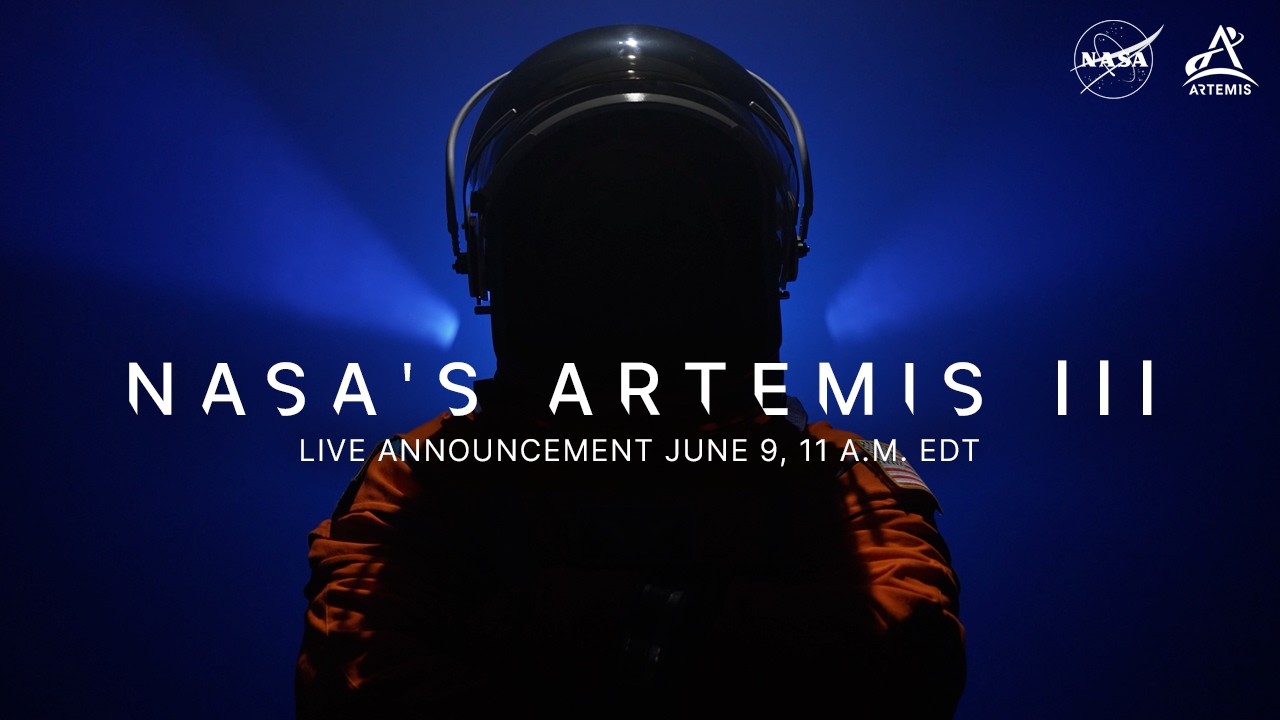
Meet the astronauts of Artemis III (Biographies)
Views: 3
Meet the astronauts of Artemis III (Full Broadcast) – by Frederic Eger, Interplanetary.tv – Photo credit: AI generated – Video credit: NASA –
NASA Redefines Artemis III as Low Earth Orbit Docking Test for Late 2027
NASA has formally redesigned the Artemis III mission, shifting from a lunar landing to a 3–4 week Low Earth Orbit (LEO) rendezvous and docking test scheduled for late 2027. This strategic pivot, announced in February 2026, repositions Artemis IV as the program’s first lunar landing mission in 2028 at the Moon’s South Pole.
The redesign addresses technical realities while preserving the program’s core objectives. Artemis III will now serve as a critical validation of docking infrastructure with commercial lunar landers before surface operations commence. The mission profile centers on proving Orion’s docking system performance with SpaceX Starship HLS and Blue Origin Blue Moon Mk2 pathfinders, executing the first-ever demonstration of commercial lander interface compatibility.
Construction progress supports the updated timeline. The SLS core stage is currently assembled in Kennedy Space Center’s Vehicle Assembly Building, while Orion’s European Service Module undergoes acoustic testing and operations facility preparation. SpaceX and Blue Origin are preparing their respective lander pathfinders for LEO rendezvous operations, and Axiom Space’s AxEMU spacesuits have completed first microgravity testing for future lunar surface walks.
Biographies:
Commander Randy Bresnik (NASA)
Randy “Komrade” Bresnik, born 11 September 1967 in Fort Knox, Kentucky, is a NASA astronaut and Marine Corps test pilot chosen for Artemis III as commander. He joined NASA in 2004 (Astronaut Group 19) and previously flew on STS-129, the only Artemis crew member with Space Shuttle experience. Bresnik commanded ISS Expeditions 52/53 and logged over 32 hours of spacewalk time. Trained at TOPGUN and the Marine Corps Weapons and Tactics course, he served during Operation Iraqi Freedom. As Assistant-to-the-Chief of the Astronaut Office for Exploration, he led exploration crew preparation. He is married with three children.
Pilot Luca Parmitano (ESA)
Luca Parmitano, born 27 September 1976 in Paternò, Sicily, is an ESA astronaut and Italian Air Force colonel selected as Artemis III pilot. Selected by ESA in 2009, he flew Volare (Expedition 36/37, 2013) and Beyond (Expedition 60/61, 2019–2020), accumulating 366 days in space. He became the first Italian to perform extravehicular activity, executing six spacewalks totaling 33 hours and 9 minutes, and commanded Expedition 61. A test pilot trained at EPNER in France, he has 2,000 flight hours across 40 aircraft types. Currently ESA’s liaison at Johnson Space Center, he serves as CapCom and trainer. He is married.
Mission Specialist Frank Rubio (NASA)
Frank Rubio, born 11 December 1975 in Los Angeles, is a NASA astronaut and U.S. Army medical officer selected as Artemis III mission specialist. Part of NASA’s 2017 Candidate Class (Group 22), he holds the record for the longest single-duration spaceflight by a U.S. astronaut—371 days aboard the ISS during Expeditions 67/68/69 in 2022–2023. He traveled 157,412 statute miles, worked with 28 astronauts, and completed three spacewalks totaling 21 hours and 24 minutes. Rubio helped install two new IROSA solar arrays on the ISS and recently served as Class Advisor for the 2025 Astronaut Candidate Class. He is married with four children.
Mission Specialist Andre Douglas (NASA)
Andre Douglas, born 11 December 1985 in Miami, Florida, is a NASA astronaut and former U.S. Coast Guard officer selected as Artemis III mission specialist. He was the backup astronaut for Artemis II and trained with the crew including Reid Wiseman, Victor Glover, Christina Koch, and Jeremy Hansen. Douglas joined NASA’s 2021 Candidate Class (Group 23) and previously served as an engineer at the Applied Physics Laboratory supporting the DART planetary defense mission and the MEGANE instrument for Mars Moons eXploration. He was part of the Lunar Surface Innovation Consortium. Born in Miami, he is married with two sons.
All four astronauts will now begin rigorous training on Orion spacecraft systems and human landing system operations for Artemis III, planned as a crewed Earth-orbit test flight in late 2027. Bob Hines serves as backup crew member.
The mission sequence begins with SLS launch from Pad 39B carrying four astronauts aboard Orion. After final system checks in low-Earth orbit, the European Service Module propels the spacecraft to circular LEO. Orion then approaches commercial landers for docking—the mission’s pivotal operational milestone. Crew members will spend extended time aboard Orion, longer than Artemis II’s 10 days, testing life support systems and potentially entering at least one lander test article to evaluate interface systems.
Verification activities will span life support, communications, propulsion and navigation across all docked vehicles, including testing of an upgraded heat shield for more flexible reentry profiles. After undocking, the European Service Module fires its main engine for return trajectory—no gravity assist required for LEO. The Crew Module separates, reenters at approximately 40,000 km/h, deploys eleven parachutes and splashes down in the Pacific Ocean.
Post-mission analysis beginning late 2027 will examine docking performance, life support data and systems verification results. These findings inform lander rendezvous and habitation concepts for future lunar surface missions. By 2028, Artemis IV will execute the first crewed lunar landing, utilizing AxEMU spacesuits tested during Artemis III. This foundation supports enduring human presence on the lunar surface, including future Moon base construction. The redesign maintains Artemis III’s vital role: validating the technologies and operational procedures essential for humanity’s return to the Moon.
— Frederic Eger
About the Author
Frederic Eger (1975), trailblazing Israeli-Argentine-French journalist, author, and filmmaker, drives media innovation since 1998. He dives deep into science, technology, space, and geopolitics. With a BA in History from the Sorbonne and BA equivalent (professional program certificate) in Film & TV Production from UCLA, Frederic Eger belongs to the next-generation Zionist thinkers, unveiling books such as Albert Einstein: The Father of Federal Zionism (2025)(http://amazon.com/dp/9934384531), One State Solution (2026) (https://amazon.com/dp/9934936909), and Globalize Zionism (2027) in the book series #ZionismNextThinkers.
0 Comments