
India’s orbit: why the launch “hat‑trick” remains out of reach?
Views: 4
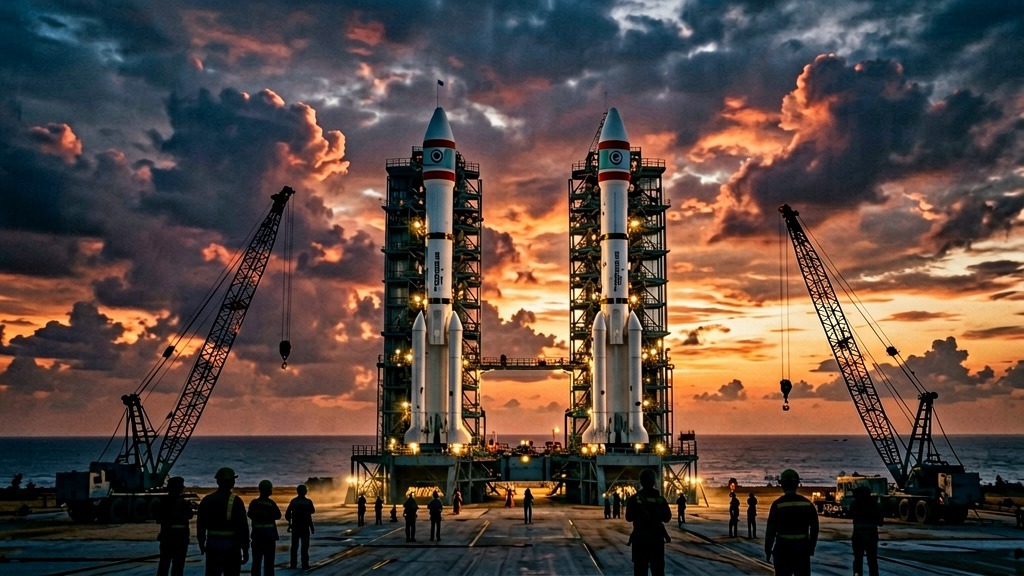
India’s orbit: why the launch “hat‑trick” remains out of reach – By Frederic Eger, Interplanetary.tv – Photo credit: AI generated – Trailer Video credit: ISRO – India’s space program is at a turning point. The country has built a reputation for being disciplined, inventive, and remarkably efficient with limited resources. But there’s a catch: chronic capacity shortfalls keep India from hitting the combination every major spacefaring nation has mastered—frequent launches, powerful lift, and built-in redundancy. That “orbital hat-trick” remains elusive, and frankly, the math makes it tough to argue otherwise.
Jatan Mehta pulls no punches in his review of where things stand. Look ahead to 2031-2040, and India will need at least 380 launches—about 38 a year—to honor its civil, scientific, and defense promises. Stack up all the present and upcoming launchers—PSLV, LVM3, the next-gen NGLV, and new private entrants—and the absolute theoretical maximum stretches to 45 launches a year. Reality, though, will probably mean more like 20 to 25. This isn’t just about numbers. The shortfall runs deeper, right into how the system is built and funded.
Money is a big part of the story. The Department of Space has just $1.5 billion budgeted for FY2026—a figure that hasn’t moved for years. Flagship projects like NGLV get greenlit, but funds actually arrive in drips, leaving engineering teams stuck with idle periods and breaking up project flow. And ISRO itself often leaves budgeted money unspent, which only makes things worse.
Chronology:
Launch capabilities, Human Spaceflight & Solar System Exploration (1963–2026)
1960s–1970s: Foundation and First Rockets
1963: First rocket launch from Thumba, Kerala (NGA-700)— Launch capability (first flight)
1969: ISRO formally established (August 15) by Dr. Vikram Sarabhai — Organization creation
1970s: Development of Satellite Launch Vehicle-3 (SLV-3) — Launch capability development
1979: First SLV-3 test flight (failed) — Launch capability test
1980s–1990s: First Orbital Success and Early Lunar/Mars Ambitions
1980: SLV-3 successfully launches Rohini satellite → India becomes 6th nation to achieve spaceflight — Launch capability: first orbital success1984: Rakesh Sharma (Indian Air Force pilot) flies to Salyut 7 with Soviet cosmonauts → India’s first astronaut — Human spaceflight: first Indian astronaut (foreign launch)
1980s–1990s: Development of PSLV (Polar Satellite Launch Vehicle) and GSLV (Geosynchronous Satellite Launch Vehicle) — Launch capability expansion
1990s: PSLV becomes cornerstone for polar satellite deployments; commercial launches begin — Launch capability mature
2000s–2010s: Lunar Exploration, Mars Success, and Heavier Launch Vehicles
2008: Chandrayaan-1 orbiter launched → first Indian mission to Moon; discovered water on lunar surface — Solar system exploration: Moon2013: Mars Orbiter Mission (Mangalyaan) development begins — Solar system exploration: Mars
2014: Mangalyaan successfully enters Mars orbit (Sept 23) → India becomes 4th entity to orbit Mars — Solar system exploration: Mars
2014–2017: GSLV Mk-II operational; LVM3 (GSLV Mk-III) develops into heavy-lift vehicle (8 tonnes to LEO) — Launch capability: heavy-lift
2017: LVM3 first full vehicle flight (planned 2009, delayed to 2017) — Launch capability milestone
2020s: Chandrayaan Success, Human Spaceflight Program, and Future Roadmap
2023: Chandrayaan-3 successfully lands near Moon’s south pole → India becomes 4th nation to soft-land on Moon, 1st at south pole — Solar system exploration: Moon2023: Prime Minister Modi announces Bharatiya Antariksha Station by 2035, crewed Moon landing by 2040 — Human spaceflight roadmap
2024–2025: Gaganyaan test missions completed; human spaceflight program advances — Human spaceflight: preparation
2025: ISRO unveils 40-year roadmap (2025–2065):
– 2035: Indian space station (Bharatiya Antariksha Station) — Human spaceflight
– 2040: First Indian astronaut on Moon — Human spaceflight: Moon
– 2047: Crew station on Moon, 3D-printed lunar dwellings, propellant depots, lunar terrain vehicles — Moon colonization
– Post-2047: Human Mars landing, 3D-printed dwellings on Mars — Mars colonization2025–2026: Development of Lunar Module Launch Vehicle (LMLV): 80 tonnes to LEO, 27 tonnes to trans-lunar orbit; 119m tall; ready by 2035 — Launch capability: future super-heavy
2026: Goal: 150-tonne payload to orbit in single mission (upgrade from current 8 tonnes LEO) — Launch capability vision
KEY LAUNCH VEHICLE EVOLUTION
Vehicle: SLV-3
Payload Capacity: 40 kg to orbit
Status: 1980–1983
Notes: First orbital rocketVehicle: ASLV
Payload Capacity: 150 kg to LEO
Status: 1987–1994
Notes: Augmented SLV; limited successVehicle: PSLLV
Payload Capacity: 1,750 kg to SSO
Status: Operational
Notes: Polar satellite launches; commercial successVehicle: GSLV Mk-II
Payload Capacity: 2,500 kg to GTO
Status: Operational
Notes: Medium-lift; cryogenic engineVehicle: LVM3 (GSLV Mk-III)
Payload Capacity: 8 tonnes to LEO, 4 tonnes to GTO
Status: Operational
Notes: Heavy-lift; used for Chandrayaan-3, GaganyaanVehicle: NGLV (Next-Gen Launch Vehicle)
Payload Capacity: TBD (reusable, heavy-lift)
Status: Development
Notes: Expected operational 2030sVehicle: LMLV (Lunar Module LV)
Payload Capacity: 80 tonnes to LEO, 27 tonnes to trans-lunar
Status: Development (by 2035)
Notes: For Moon missions, crewed lunar landingVehicle: Future LV
Payload Capacity: 150 tonnes to orbit
Status: Vision 2040s
Notes: Super-heavy for Mars colonizationHUMAN SPACEFLIGHT TIMELINE
1984: Rakesh Sharma flies to Salyut 7 (first Indian astronaut, foreign launch)2018: Modi announces Gaganyaan crewed flight target (initially 2022)
2023–2025: Gaganyaan test missions completed; human-rating LVM3 progresses
2035: Bharatiya Antariksha Station (Indian space station) planned
2040: First Indian astronaut on Moon planned
SOLAR SYSTEM EXPLORATION AND COLONIZATION ROADMAP
MOON
2008: Chandrayaan-1 orbiter; discovered lunar water2023: Chandrayaan-3 soft-lands at Moon’s south pole (4th nation, 1st at south pole)
2025: Chandrayaan-4 (lunar sample return) planned by end of decade
2047: Crew station on Moon, 3D-printed lunar dwellings, propellant depots, lunar terrain vehicles
MARS
2014: Mangalyaan enters Mars orbit (4th entity to orbit Mars)
Post-2047: Human Mars landing, 3D-printed dwellings on Mars
Future: Return missions to Mars, scientific exploration
VENUS AND BEYOND
Future: Venus orbiter mission planned (delayed by 5 years due to LVM3 constraints)
Future: More Mars sample return, Jupiter/Saturn fascia missions possible
SUMMARY: ISRO’S TRAJECTORY (1963–2026)
ERA: 1960s–1970s
Launch Capability: First rocket flight (1963); SLV-3 development
Human Spaceflight: None
Solar System Exploration: None
Colonization Vision: NoneERA: 1980s–1990s
Launch Capability: First orbital success (1980); PSLV operational
Human Spaceflight: First astronaut (1984, foreign)
Solar System Exploration: None
Colonization Vision: NoneERA: 2000s–2010s
Launch Capability: GSLV Mk-II, LVM3 heavy-lift
Human Spaceflight: Planning Gaganyaan
Solar System Exploration: Chandrayaan-1 (2008), Mangalyaan (2014)
Colonization Vision: NoneERA: 2020s
Launch Capability: LVM3 operational; NGLV, LMLV developing
Human Spaceflight: Gaganyaan tests; 2035 space station target
Solar System Exploration: Chandrayaan-3 (2023, south pole)
Colonization Vision: 2040 Moon landing, 2047 lunar habitat, post-2047 Mars humans
KEY TAKEAWAY:
ISRO evolved from a nation reliant on foreign launches (1963) to a self-reliant space power with heavy-lift rockets, lunar south pole landing, Mars orbiter, and a 40-year roadmap for crewed Moon landing (2040), lunar colonization (2047), and human Mars mission (post-2047).
Disclosure Advocacy: The Decades-Long Campaign.
The industry’s structure isn’t helping either. Most Indian private launch companies work in an environment with little government support, not much demand for small-satellite launches, and rare co-investment for new facilities. The US response—hand over major responsibilities to private players—won’t transfer smoothly to India. Mehta argues for measured competition and smart technology transfers instead, hoping to spark a more self-reliant production ecosystem.
Operational fixes are on the table. Separate launch pads for human missions and for heavy payloads would ease bottlenecks and let robotic missions and crewed flights run on their own timelines. Encouraging private companies to build their own infrastructure would lift a burden off ISRO. Mehta nods to China’s approach to crewed launches—not that India should copy them exactly, but the need for parallel, not serial, development is clear.
In the end, there’s no single magic vehicle missing from India’s lineup—no need for a Saturn V replica. What the country does need is investment in ground facilities, a faster path to getting NGLV ready for work, and policy that treats launch capability as a critical piece of national infrastructure, not just a project-by-project expenditure. The payoff? Control over its own lunar missions and a robust, diversified launch market. But it’ll take focused political backing and real money to transform technical talent into long-term spaceflight muscle. Right now, that’s where the real challenge sits.
https://en.wikipedia.org/wiki/Stephen_Bassett_(lobbyist)
https://en.wikipedia.org/wiki/Steven_M._Greer
— Frederic Eger
About the Author
Frederic Eger (1975), trailblazing Israeli-Argentine-French journalist, author, and filmmaker, drives media innovation since 1998. He dives deep into science, technology, space, and geopolitics. With a BA in History from the Sorbonne and BA equivalent (professional program certificate) in Film & TV Production from UCLA, Frederic Eger belongs to the next-generation Zionist thinkers, unveiling books such as Albert Einstein: The Father of Federal Zionism (2025)(http://amazon.com/dp/9934384531), One State Solution (2026) (https://amazon.com/dp/9934936909), and Globalize Zionism (2027) in the book series #ZionismNextThinkers.
0 Comments