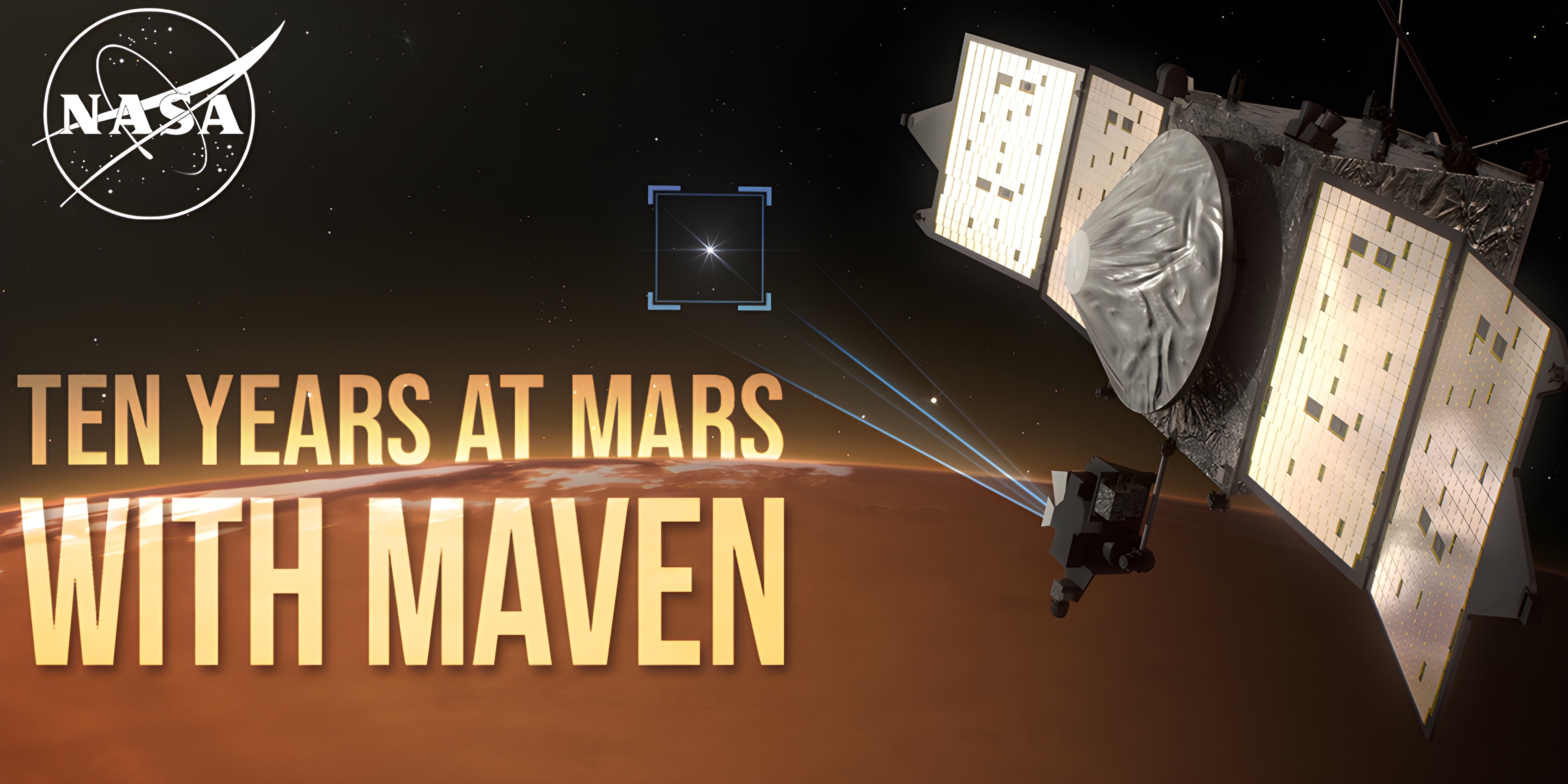
NASA’s MAVEN Orbiter Declared Lost After Communication Failure – by Frederic Eger, Interplanetary.tv – Photo credit: AI generated – Video credit: NASA – NASA’s Mars orbiter, MAVEN, finally reached the end of its journey. After months without a signal, engineers gave up hope of reviving it, closing the book on a mission that reshaped our understanding of Mars. This probe didn’t just orbit the Red Planet—it pieced together the story of how Mars’ thin atmosphere slipped away over time, revealing why the planet now looks so barren. MAVEN’s last transmission came back on December 6, right before it disappeared behind Mars. For months, NASA teams tried every trick to reach it, but nothing worked. It’s a quiet farewell, but the mission leaves behind a legacy that scientists will mine for decades.
While one mission fades, another gears up for its debut. The Nancy Grace Roman Space Telescope just passed the final inspection of its primary mirror—a moment those in the field look forward to with anticipation and anxiety. This step is not just a milestone; it signals that NASA almost has another flagship observatory ready to go. Engineers are prepping to ship the telescope to Florida, and the schedule holds steady for an early September launch, with rumors swirling it could even happen late August. Roman promises to transform astronomy with its wide-angle view, imaging thousands of galaxies at once and probing mysteries like dark energy. It’s hard not to feel the excitement building as this telescope inches toward liftoff.
Chronology
Nov. 18, 2013 — MAVEN launched from Cape Canaveral aboard an Atlas V rocket.
Sept. 21, 2014 — MAVEN entered orbit around Mars, beginning its science mission to study the upper atmosphere and atmospheric escape.
2014–2017 — The spacecraft collected long-term measurements of the Martian upper atmosphere, helping scientists understand how Mars lost much of its atmosphere over time.
June 2018 — During a global dust storm, MAVEN observed a major increase in water loss to space, strengthening the link between dust storms and atmospheric escape.
Feb.–Apr. 2019 — MAVEN performed aerobraking to tighten its orbit and improve communications relay support for surface missions while continuing science operations.
2020–2024 — MAVEN continued extended operations, serving both as a science orbiter and communications relay asset.
Dec. 6, 2025 — NASA last received a signal from MAVEN after it passed behind Mars; the spacecraft later became silent and was considered unrecoverable.
June 3, 2026 — NASA announced the end of MAVEN’s mission and began decommissioning after a review concluded the spacecraft could no longer perform science or relay functions.
June 2026 — MAVEN’s operational mission was formally over, ending more than 11 years in orbit at Mars.
Mission significance
MAVEN was NASA’s first mission dedicated specifically to understanding the Martian upper atmosphere. Its data helped explain how solar wind and space weather gradually stripped away Mars’s atmosphere, shaping the planet’s long-term climate evolution.
Timeline Summary:
Nov. 18, 2013 Launch from Cape Canaveral.
Sept. 21, 2014 Mars orbit insertion.
June 2018 Global dust storm observations of accelerated water loss.
Feb.–Apr. 2019 Aerobraking campaign to lower orbit.
Dec. 6, 2025 Last contact with MAVEN.
June 3, 2026 NASA ended the mission.
Money and logistics aren’t the only concerns here. After big failures like this, watchdogs on Capitol Hill and within NASA itself want to know what went wrong and how Blue Origin runs its shop. The way the company shares information, fixes the problem, and works with regulators will affect its reputation and future contracts. They’re under a microscope now.
All this played out at the same time as a far more peaceful spectacle—a rare Blue Moon, the second full moon in a month, captured the public’s attention. For a moment, stargazers got to marvel at the sky, a welcome distraction from the engineering chaos back on Earth. It’s a sharp reminder that space isn’t just about risk and failure—sometimes, it’s simply about awe.
As the investigation into New Glenn moves forward, NASA and its partners are forced to consider how they’ll keep their lunar commitments without losing sight of reality. Whatever decisions follow won’t just shuffle launch dates—they’ll also decide whether private industry can really deliver on deep space exploration, and how much faith the public will have in those promises.
— Frederic Eger
About the Author
Frederic Eger (1975), trailblazing Israeli-Argentine-French journalist, author, and filmmaker, drives media innovation since 1998. He dives deep into science, technology, space, and geopolitics. With a BA in History from the Sorbonne and BA equivalent (professional program certificate) in Film & TV Production from UCLA, Frederic Eger belongs to the next-generation Zionist thinkers, unveiling books such as Albert Einstein: The Father of Federal Zionism (2025)(http://amazon.com/dp/9934384531), One State Solution (2026) (https://amazon.com/dp/9934936909), and Globalize Zionism (2027) in the book series #ZionismNextThinkers.

0 Comments