
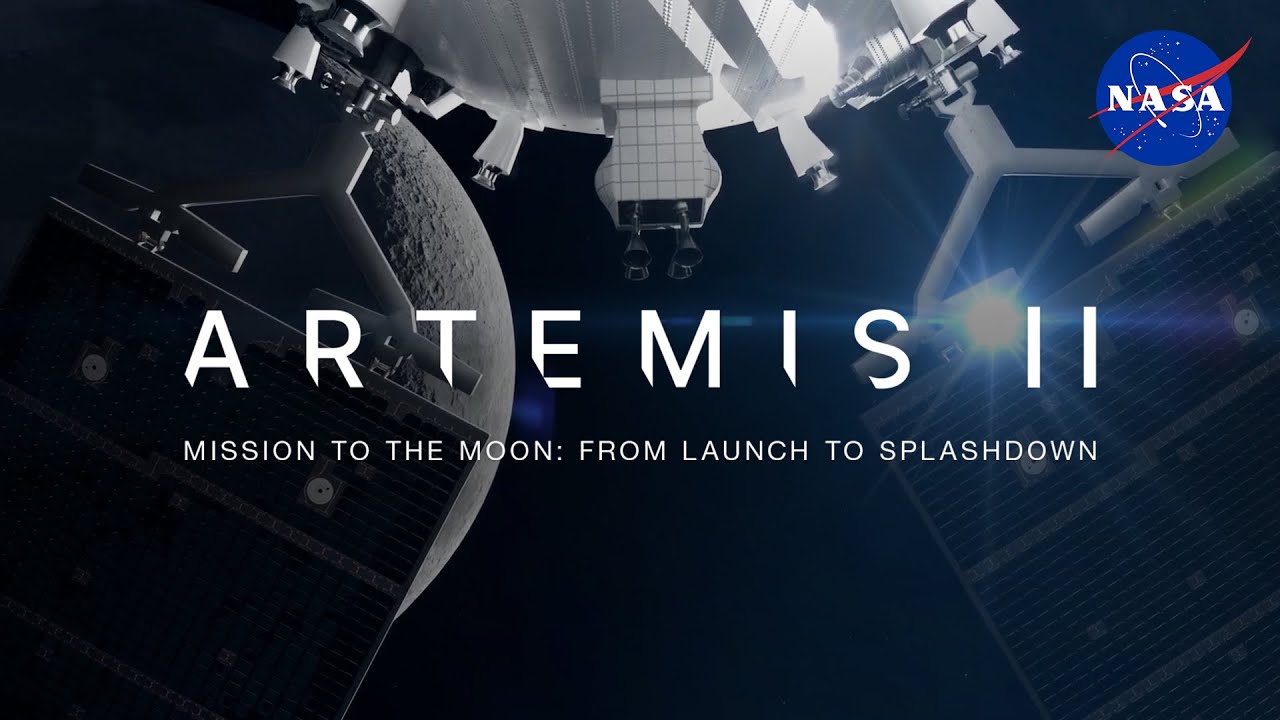
NASA’s Artemis 2 Crew Moon Flyby (Day 6)
NASA’s Artemis II Crew Moon Flyby (Official) Rating U — UNIVERSAL (ALL AGES): NASA’s Artemis II mission delivered a historic 10-hour Moon flyby on April 6, 2026, as the Orion spacecraft Integrity carried four astronauts on a 35?hour lunar circuit roughly 4,000 miles above the surface. The crew—Commander Reid Wiseman, pilot Victor Glover, mission specialist Christina Koch, and Canadian Space Agency mission specialist Jeremy Hansen—tracked the Moon’s features for about seven hours of focused observation, including both the near and far sides, as part of the roughly 10?day test flight around the Moon and back to Earth. During this window, the astronauts documented lunar regions never before seen by humans, captured dramatic horizon?skimming lunar vistas, and even observed a rare in?space solar eclipse as the Moon briefly blocked the Sun. The Orion spacecraft reached a peak distance of about 252,760 miles from Earth, setting a new human?spaceflight distance record and surpassing the Apollo 13 milestone by more than 4,000 miles. Mission controllers on the ground used the flyby to verify Orion’s navigation, life?support, communications, and thermal systems in deep space, confirming that the vehicle can protect a crew on the longer journeys required for future Artemis lunar?landing and Mars?preparation missions. The trajectory was designed as a “free return” loop, harnessing the Moon’s gravity to swing the spacecraft around the far side and then naturally pull it back toward Earth without a major propulsion burn, minimizing propellant use and maximizing safety. As the astronauts folded the Moon behind them and began the homeward leg, they spotted an “Earthrise” over the lunar horizon and continued monitoring systems for the final days of the mission, ahead of a planned Pacific Ocean splashdown near San Diego on April 10. The Artemis II flyby thus provided not only stunning imagery and a distance record but also essential proof that NASA’s SLS rocket, Orion spacecraft, and ground operations can reliably support humans in deep space, laying the technical foundation for the return of astronauts to the lunar surface and, ultimately, for crewed missions to Mars. - International equivalents: MPAA: G | BBFC: U | CSA: Tous publics | FSK: 0 | CBFC: U | OFLC: G | CRTC: C | NICAM: AL No content that could disturb, frighten or harm children of any age. No violence beyond slapstick, no crude humour, no romantic content, no supernatural threat, no scary imagery, and no language beyond mild colloquial terms. Fully appropriate for unsupervised viewing by all ages, including infants. Content Warnings Required: None.
Upcomming


Add Review
You have to Sign In to share the review