
Israel’s National AI Directorate: Strategic Ambition Meets Execution Reality
Views: 7
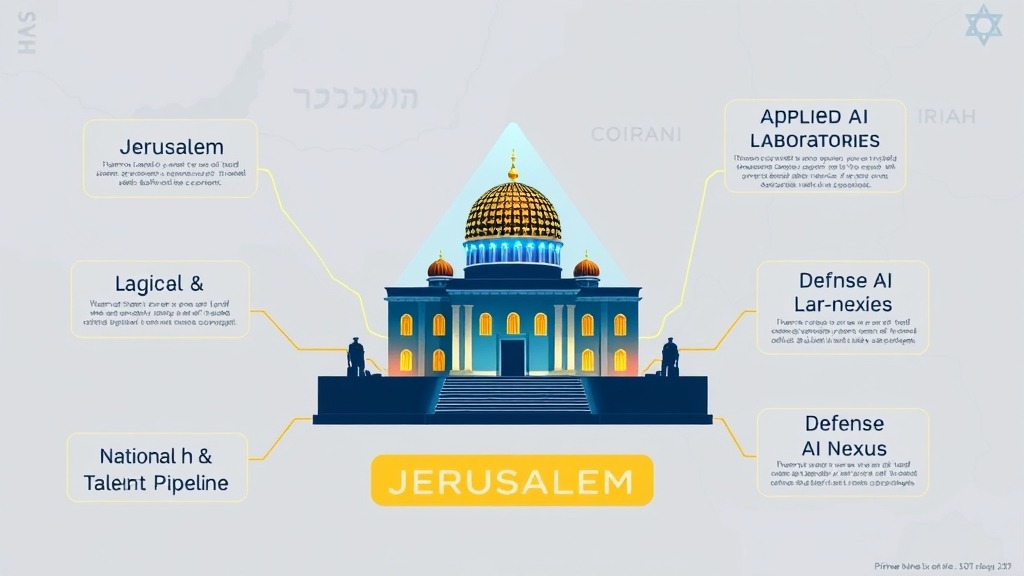
Israel’s National AI Directorate: Strategic Ambition Meets Execution Reality – by Frederic Eger, Interplanetary.tv – Photo credit: AI generated – Video credit: ILTV – On 11 May 2026, Israel’s cabinet unanimously approved the preliminary work plan of the National Artificial Intelligence Directorate—a body established only in September 2025 within the Prime Minister’s Office. Led by Brigadier General (Res.) Erez Askal, former commander of Unit 9900 (Israel’s geospatial intelligence unit), the Directorate represents Israel’s formal response to mounting strategic pressure: the Nagel Committee’s stark warning that “Israel is not in a good position to accelerate the field,” alongside the operational failures exposed by 7 October 2023.
The approved plan funds three pillars: (1) human capital—retaining elite AI researchersagainst brain drain to the U.S.; (2) supercomputing infrastructure—a national HPC cluster built by Nebius, expected online in early 2026; and (3) applied AI laboratories embedded in government ministries for transportation, health, education, and energy. A strategically critical but undercovered commitment involves Hebrew and Arabic NLP development—AI that can reason natively in the region’s languages is essential for intelligence work.
The Directorate’s placement in the PMO—not the Innovation Ministry—signals AI is treated as a national security matter, not merely economic competitiveness. However, this centralization raises governance concerns: Askal was appointed without public tender; the timing coincided with holidays minimizing public scrutiny; and a defense-tech fund launched by Netanyahu adviser Dovi Frances added Avner Netanyahu to its team two months before the Directorate’s approval. No impropriety is proven, but transparency deficits are documented..
Chronology
2023 — context and immediate aftermath
7 October 2023 — Hamas-led invasion and war begins. Operational failures in intelligence and field communications expose gaps in situational awareness and decision-support systems, driving urgent interest in applied AI for military and intelligence uses. (Public)
October–December 2023 — Rapid mobilization of defense-tech efforts: increased procurement and experimentation with AI-enabled ISR (intelligence, surveillance, reconnaissance), image/video analysis, and automated translation/transcription tools to process battlefield and social-media feeds. (Public reporting; Inference)
December 2023 — Israel publishes a National AI Program (or similar national AI initiative) with announced budgets and projects; reporting later shows slow disbursement. (Eger; Public)
2024 — intensification of defense & intel AI efforts
Early–mid 2024 — Defense establishments accelerate deployment of AI systems for tactical situational awareness, geospatial analysis, video analytics, and automated triage of vast sensor feeds. Unit 9900 (geospatial intelligence) and other units expand AI use. (Public; Inference)
2024 — Increased partnerships between Israel Defense Forces (IDF), intelligence agencies, domestic defense contractors, and startups focusing on computer vision, NLP for Hebrew/Arabic, cyber-AI tooling, and robotic systems integration. (Public)
2024 — Reports of talent movement: Israeli researchers and engineers attracted by defense and cyber funding; some loss of researchers to U.S. labs persists (brain drain). (Eger; Public)
2025 — institutionalization and governance moves
September 2025 — Israel establishes the National Artificial Intelligence Directorate (NAID) within the Prime Minister’s Office. Leadership: Brig. Gen. (Res.) Erez Askal (former Unit 9900 commander). Placement in PMO signals prioritization of AI as national security infrastructure rather than only an innovation/economy matter. (Eger; Public)
Late 2025 — Political scrutiny: appointments and timing prompt transparency questions (appointment without public tender; concurrent defense-tech fund activity involving political figures). (Eger)
Throughout 2025 — Civilian AI program budget execution lags; Eger reports the December 2023 National AI Program released only ~20% of its budget by April 2025. Defense AI budget commitments remain very large in comparison. (Eger)
2025–early 2026 — infrastructure and capability building
Late 2025–early 2026 — Contracting and preparations for a national HPC/supercomputing initiative led by Nebius (private company named in Eger’s piece), intended to be operational early 2026 to support applied AI workloads for government ministries and intelligence needs. (Eger)
2025–2026 — NAID plans three pillars: (1) human capital retention to prevent brain drain to U.S.; (2) supercomputing infrastructure (national HPC cluster); (3) applied AI labs embedded in ministries (transportation, health, education, energy). (Eger)
Emphasis on Hebrew and Arabic NLP development is identified as strategically critical for intelligence and regional operations. (Eger)
11 May 2026
Cabinet unanimously approves the National Artificial Intelligence Directorate (NAID) work plan. Initial civilian budget: NIS 120 million (~$41.5M). (Eger/Public)
NAID placed in the Prime Minister’s Office (not the Innovation Ministry); appointment of Brig.-Gen. (Res.) Erez Askal and near-timed defense‑tech fund staffing raise transparency questions in coverage. (Eger)
May–June 2026
Implementation starts: procurement, staffing, early contracts for HPC and ministerial applied‑AI labs. Nebius’ national HPC was expected online in “early 2026” (status to be confirmed). (Eger/Public/Inferred)
Defense AI commitments remain far larger than civilian allocations (Eger cites ~NIS 350B over a decade), shaping talent and capacity flows. (Eger)
Mid‑2026 posture (current)
Israel unlikely to train frontier foundation models at OpenAI/Google scale. Focus instead on applied/operational defense AI, cybersecurity tooling, regional‑language NLP (Hebrew/Arabic), and robotics/systems integration. (Eger/Inferred)
Mid‑2026 → Mid‑2028 (near term — deliverables to watch)
HPC cluster operationalization and migration of select government workloads. (Eger/Inferred)
Launch/scale of ministerial applied‑AI labs delivering prototypes for transport, health, education, energy (with dual‑use potential). (Eger/Inferred)
Accelerated Hebrew and Arabic NLP models for intelligence, monitoring, and regional tasks. (Eger)
Continued defense‑industry productization: ISR analytics, logistics optimization, autonomous systems integration. (Public/Inferred)
Near‑term risks.
Budget execution and transparency will determine whether NAID accelerates new work or merely reorganizes existing efforts. (Eger)
Opaque contracting or political ties could invite criticism if civilian priorities are subordinated to defense or patronage. (Eger/Inferred)
Talent retention remains challenging without stronger incentives; targeted fellowships and cleared career tracks may help. (Eger/Inferred)
2028–2035 (medium term)
Likely outcome: Israel leads in defense‑applied AI, regional NLP, cybersecurity tools, and robotics integration, but does not rival US/Big Tech in large‑scale foundation models. (Eger/Inferred)
Civilian AI growth depends on whether NAID balances security and economic objectives; otherwise civilian ecosystem may lag. (Inferred)
Israel’s execution record is weak: the December 2023 National AI Program released only 20% of its budget by April 2025, with flagship projects unbuilt. The new Directorate’s initial budget—NIS 120 million (~$41.5M)—is trivial compared to the U.S. CHIPS Act ($52B) or UK commitments (£1B). Defense AI spending (NIS 350B over a decade) dwarfs civilian allocations by ~900x.
Realistic outcomes: Israel will not train frontier foundation models competing with OpenAI or Google. Its asymmetric advantage lies in combat-proven military AI (unmatched operational data since October 2023), AI infrastructure/security tooling (leveraging its cybersecurity dominance), and physical AI/robotics (where systems integration matters more than compute scale).
Verdict: Israel will punch above its weight in applied and defense AI—as it always has. Whether the Directorate accelerates delivery or merely reorganizes existing structures depends on the next 24 months of budget execution. The political architecture may serve the mission—or serve the politics.
— Frederic Eger
About the Author
Frederic Eger (1975), trailblazing Israeli-Argentine-French journalist, author, and filmmaker, drives media innovation since 1998. He dives deep into science, technology, space, and geopolitics. With a BA in History from the Sorbonne and BA equivalent (professional program certificate) in Film & TV Production from UCLA, Frederic Eger belongs to the next-generation Zionist thinkers, unveiling books such as Albert Einstein: The Father of Federal Zionism (2025)(http://amazon.com/dp/9934384531), One State Solution (2026) (https://amazon.com/dp/9934936909), and Globalize Zionism (2027) in the book series #ZionismNextThinkers.
0 Comments