
What Starship Must Prove to Serve as NASA’s Moonship
Views: 9
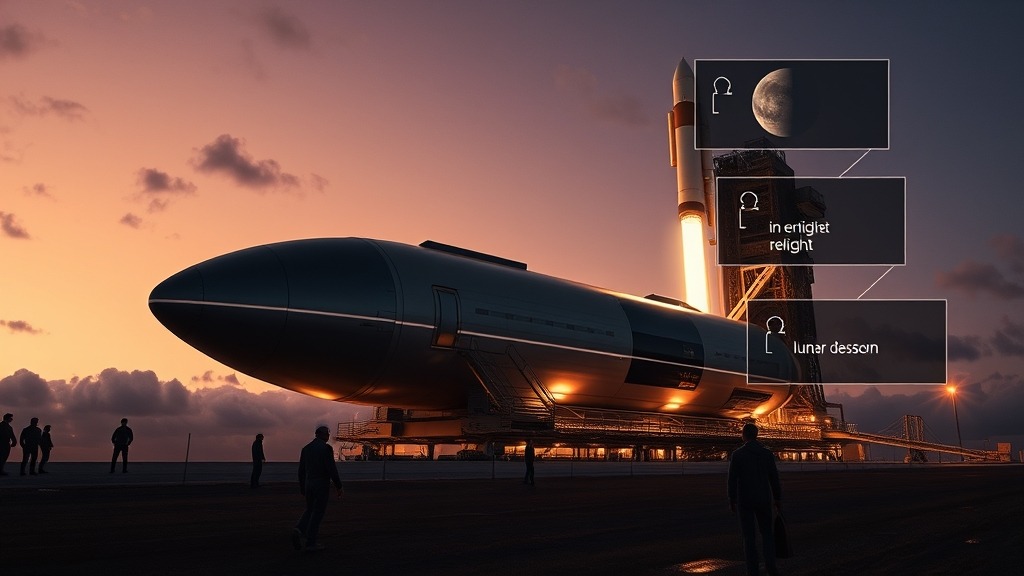
What Starship Must Prove to Serve as NASA’s Moonship – by Frederic Eger, Interplanetary.tv – Photo credit: AI generated – Video credit: SpaceX – SpaceX’s Starship sits at the center of NASA’s lunar ambitions, but it’s not ready for prime time yet. The latest suborbital test flight on May 22—the V3—delivered some real wins: flawless liftoff, clean stage separation, the upper stage made it to splashdown, and the heat shield survived reentry. Still, some key moves were missing. The test skipped demonstrating an upper-stage engine relight, and the booster didn’t stick the landing or recover softly. Each gap highlights how far Starship’s progress veers from what NASA actually needs to put astronauts safely on the Moon.
There’s a lot left on the to-do list. Starship still needs to pull off a fully stacked orbital flight. Then comes the real kicker: they have to prove, reliably and repeatedly, that the upper stage can fire up again in space. Add to that in-orbit cryogenic refueling—basically, transferring fuel between Starship vehicles while circling Earth. No one has nailed this at the scale Starship demands. When you start engineering a vehicle for humans, the hurdles get higher. You need backup avionics, life-support systems tested under real conditions, docking that works with Orion, plus solid abort options and manual controls to keep the crew safe. NASA’s own watchdogs haven’t missed this—both the Office of Inspector General and the Aerospace Safety Advisory Panel point to major risks, like not having enough uncrewed demonstration flights and real worries about how a rocket this tall and skinny might land upright on rough lunar ground.
Starship V3 Test Flight
SpaceX launched the upgraded Starship V3 from Starbase, Texas, after an earlier delay caused by pad issues, and the rocket lifted off successfully with its Super Heavy booster lighting all 33 engines at ascent. The vehicle climbed on a suborbital trajectory, with the flight intended to demonstrate the first mission of the Version 3 stack and a step toward future lunar and Mars operations.
During ascent, the booster experienced engine trouble: reports indicate that not all engines remained lit throughout the burn, but the vehicle still continued downrange. Stage separation then occurred successfully, allowing the Starship upper stage to proceed independently while the booster began its return sequence.
After separation, the mission moved into the in-space portion of the profile. The upper stage released about 20 mock Starlink satellites, demonstrating payload deployment capability during the test flight. The flight also included atmospheric and thermal-shield evaluation as the ship continued toward its return path.
On descent, the booster did not complete a fully controlled landing attempt and ultimately came down in the Gulf of Mexico, while the upper stage continued to the Indian Ocean. The Starship then performed its landing sequence, reached the ocean in an upright descent, and toppled after splashdown, producing the final explosion that SpaceX had anticipated for the terminal phase of the test.
In short, the sequence was: liftoff, booster ascent with some engine issues, stage separation, payload deployment, reentry, splashdown, then explosion after water impact.
Then there’s the sheer logistics. Keeping up with Artemis IV’s timeline takes more than fancy engineering: SpaceX needs fast refueling, quick turnarounds, and smooth sailing through the supply chain, regulatory approvals, and range schedules. Every engine wobble or booster mishap in recent tests casts a shadow on program timelines—especially when human lives and tight docking windows with Orion are involved.
On top of all this, the race isn’t happening in a vacuum. China’s stepping up its lunar program, with major milestones coming as early as 2025 and 2026. That’s got NASA and Congress both anxious—enough that NASA reopened the lander contract and brought Blue Origin and others back into the mix. NASA’s even starting to bend the rules a bit, easing rendezvous demands and giving more options on landing sites. Still, adjusting requirements doesn’t replace actual, successful flights.
For Starship to truly become NASA’s “Moonship,” it needs to hit every one of these critical milestones: safe, repeatable orbital missions, reliable in-space refueling, and proven lunar landing and ascent. Human-rating the vehicle demands rigorous testing with both simulations and real uncrewed flights. Until SpaceX shows those capabilities in the open—with clear schedules and solid results—NASA’s lunar return remains a lot of hope pinned against political pressure and shrinking budgets.
— Frederic Eger
About the Author
Frederic Eger (1975), trailblazing Israeli-Argentine-French journalist, author, and filmmaker, drives media innovation since 1998. He dives deep into science, technology, space, and geopolitics. With a BA in History from the Sorbonne and BA equivalent (professional program certificate) in Film & TV Production from UCLA, Frederic Eger belongs to the next-generation Zionist thinkers, unveiling books such as Albert Einstein: The Father of Federal Zionism (2025)(http://amazon.com/dp/9934384531), One State Solution (2026) (https://amazon.com/dp/9934936909), and Globalize Zionism (2027) in the book series #ZionismNextThinkers.
0 Comments