
SpaceX Starship V3 Launch Looms Amid Tragedy at Starbase
Views: 7
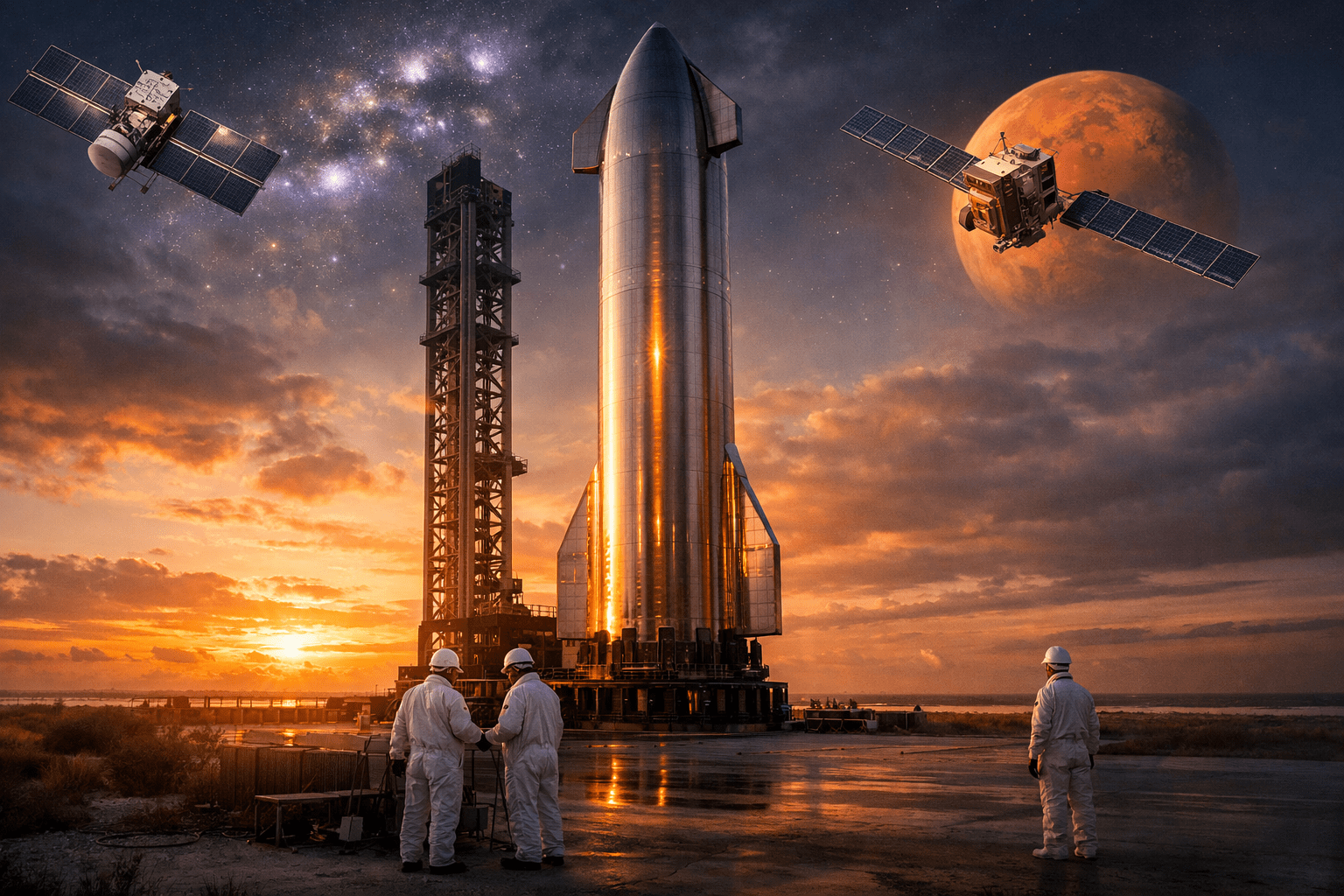
SpaceX Starship V3 Launch Looms Amid Tragedy at Starbase – by Frederic Eger, Space News Contributor – India, Interplanetary.tv – Photo credit: AI generataed – Video credit: SpaceX – SpaceX is gearing up for a pivotal moment in commercial spaceflight: the Starship V3 megarocket’s debut launch, now targeted for May 21 from Starbase in South Texas. Today, the team is conducting a wet dress rehearsal—a critical dry run that simulates launch conditions with cryogenic propellants—to validate systems ahead of liftoff. Space enthusiasts worldwide are preparing to stream the event live, with updates rolling in continuously as SpaceX pushes toward what could be the most ambitious test yet of its fully reusable super-heavy-lift vehicle.
The anticipation, however, is shadowed by tragedy. A SpaceX worker died early Friday morning (May 15) at the Starbase facility during final preparations for the Starship V3 debut. Details remain scarce, and an investigation is ongoing. The incident has cast a somber tone over what should be a celebration of engineering ambition, underscoring the inherent risks of rocket development at the frontier of human innovation.
Beyond SpaceX’s headlines, NASA is advancing a breakthrough concept that could transform space exploration: an orbital “gas station.” The Liquid Oxygen Flight demonstration satellite (LOXSAT) will test technologies for transferring and storing cryogenic propellants in space—capabilities essential for NASA’s Artemis program, which aims to return astronauts to the Moon and eventually reach Mars. In-space refueling could extend mission ranges and reduce launch costs dramatically.
Chronology of SpaceX’s Starship
Early concepts
2005: Elon Musk first floated a high-capacity rocket concept for roughly 100 tonnes to low Earth orbit, later associated with the BFR idea.
2012: SpaceX publicly announced plans for a rocket beyond Falcon 9’s capabilities, then called the Mars Colonial Transporter.
2016: The concept was renamed the Interplanetary Transport System, with a much larger all-carbon-fiber design intended for Mars and beyond.
2017: The concept was renamed BFR again before the design shifted away from carbon fiber.
December 2018: SpaceX switched the vehicle material from carbon composites to stainless steel, and the modern Starship name and architecture were introduced in 2018–2019.
Prototype phase
2019: SpaceX built and tested Starhopper, including low-altitude hops that established the basic landing and propulsion approach.
Late 2019: Full-scale Mk1 was built but destroyed in a pressure test, and later Mk2 work in Florida was abandoned.
2020: The SN-series prototypes began; SN1 and SN3 failed in ground tests, SN4 exploded after static fires, and SN5/SN6 completed 150-meter hops.
December 2020 to May 2021: SN8 through SN11 attempted higher-altitude flights, with SN8, SN9, SN10, and SN11 all ending in failures of one kind or another.
May 5, 2021: SN15 became the first high-altitude prototype to land successfully in one piece.
Orbital era
2022: FAA environmental issues delayed orbital testing while SpaceX prepared the full stacked system.
April 20, 2023: The first integrated flight test of Starship lifted off, but ended in failure after stage issues and loss of control.
November 18, 2023: Flight 2 reached space, used hot staging successfully, but both booster and ship were lost before completing the mission.
March 14, 2024: Flight 3 demonstrated more of the intended profile, including propellant transfer testing, though the vehicle was still lost before completion.
June 6, 2024: Flight 4 marked a major step forward, with both stages surviving much more of the mission and ending in controlled splashdown.
October 13, 2024: Flight 5 achieved the first booster catch at the launch tower, a major reusable-launch milestone.
November 19, 2024: Flight 6 added another booster recovery test and demonstrated an in-space engine relight.
2025 to today
January 16, 2025: Flight 7 launched successfully but ended in failure after a fire developed during the mission.
March 6, 2025: Flight 8 suffered loss of engines and control during ascent.
May 27, 2025: Flight 9 marked the first reuse of a Super Heavy booster, but the mission still ended in failure.
October 13, 2025: Wikipedia’s Starship article notes the program had flown 11 times by then, with 6 successful flights and 5 failures.
May 21, 2026: Flight 12 is the current launch, and it is the first Starship V3 flight from the new Pad 2 at Starbase.
Milestone pattern
Starship’s development has followed a clear pattern: concept changes in the 2000s and 2010s, stainless-steel prototyping in 2018–2019, low-altitude hops in 2019–2021, and increasingly ambitious integrated orbital tests from 2023 onward. The big theme is iterative testing: each flight has been used to validate a new step, such as hot staging, reentry control, propellant transfer, booster catch, and now the V3 system
Meanwhile, NASA’s Psyche asteroid-bound probe captured stunning close-up images of Mars during a gravity-assist flyby on its journey to the metal-rich asteroid 16 Psyche. The photos offer a rare glimpse of the Red Planet from an unconventional vantage point, showcasing the probe’s camera capabilities and the beauty of planetary flybys.
In astronomical discoveries, scientists have identified what they’re calling the universe’s “most relaxed” galaxy cluster—an unusually tranquil cosmic structure that defies expectations of violent mergers and turbulence. Its peaceful nature challenges existing theories about galaxy cluster evolution and offers clues about the universe’s large-scale structure.
On the entertainment front, count-down continues to this week’s release of The Mandalorian & Grogu, the latest Star Wars film. A new clip reveals how Mando retrieves his iconic ship, the Razor Crest, hinting at adventures ahead for the beloved bounty hunter and his foundling.
From Argentina’s mountains viewed from orbit to the frontiers of space technology and the mysteries of the cosmos, space professionals and fans alike stand at the intersection of triumph, tragedy, and discovery. Tomorrow’s Starship V3 launch will test not just a rocket, but humanity’s resolve to push deeper into the cosmos—even as we honor those who pay the ultimate price for progress.
— Frederic Eger
About the Author
Frederic Eger (1975), trailblazing Israeli-Argentine-French journalist, author, and filmmaker, drives media innovation since 1998. He dives deep into science, technology, space, and geopolitics. With a BA in History from the Sorbonne and BA equivalent (professional program certificate) in Film & TV Production from UCLA, Frederic Eger belongs to the next-generation Zionist thinkers, unveiling books such as Albert Einstein: The Father of Federal Zionism (2025)(http://amazon.com/dp/9934384531), One State Solution (2026) (https://amazon.com/dp/9934936909), and Globalize Zionism (2027) in the book series #ZionismNextThinkers.
0 Comments