
Lunar Outpost’s Vision: From Rovers to Cities
Views: 6
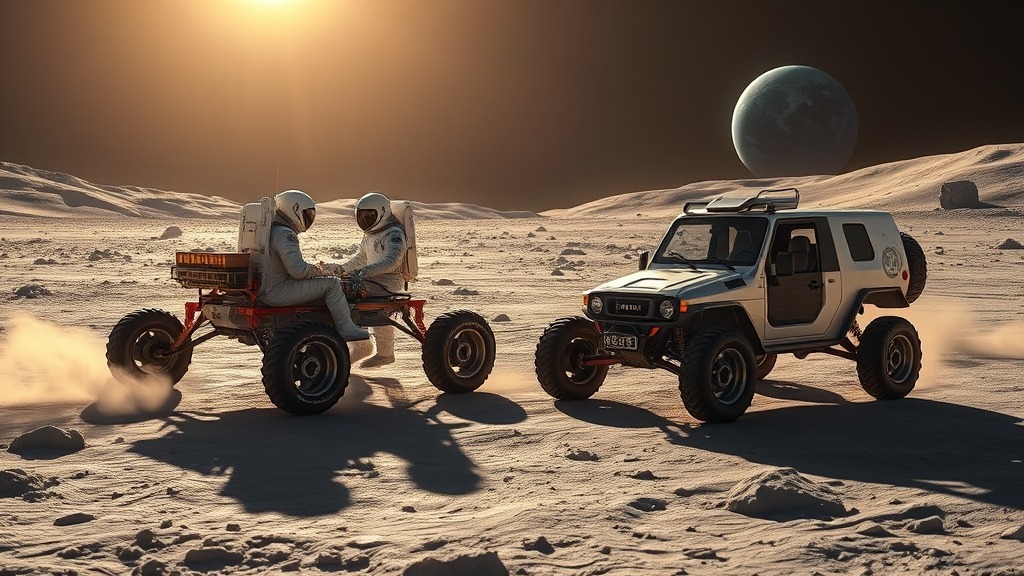
Lunar Outpost’s Vision: From Rovers to Cities – by Frederic Eger, Interplanetary.tv – Photo credit: AI generated – Video credit: SpaceX – Lunar Outpost company isn’t just selling rovers to whoever wants a machine on the moon—they’re mapping out a full-scale, systematic plan to build a lasting, mostly autonomous lunar infrastructure. This Colorado company, already recognized for the Eagle rover and its MAPP (Mobile Autonomous Prospecting Platform) mini-rover line, made headlines this month with the announcement of a $30 million Series B raise. The money’s aimed straight at Pegasus, a smaller, more nimble rover they want ready by late 2027, with deployment on the lunar surface in 2028. That timing puts Lunar Outpost alongside NASA’s Artemis program, injecting new urgency and rivalry into an industry where earthbound engineering know-how collides with the moon’s severe constraints.
Pegasus isn’t just another variant; it’s a conscious shift. Toned down from the larger, SUV-like Eagle, it conjures up echoes of the lean Apollo-era buggies—only now wired for autonomy and modular teamwork. Lunar Outpost’s promotional materials push this vision: robots and humans working as real collaborators, not just in isolation or sequence. Leadership at the company stresses Pegasus as one element—think of it as a building block, not a finished solution—in a whole system devoted to lunar surface prep, habitat support, energy reserves, and even launchpad construction. “We’re a lunar infrastructure company, and the infrastructure of the moon base won’t be built by astronauts alone,” the vice president of strategy. Robots, or autonomous systems, sit at the core of their strategy.
Company Milestones
Founded (approx. 2017): company established in Golden/Denver, Colorado by Justin Cyrus as Founder and CEO.Development of Eagle rover: created a larger, SUV-like rover platform (Eagle) as an early flagship product.
Creation of MAPP line: launched the MAPP (Mobile Autonomous Prospecting Platform) mini-rover series for prospecting and surface work.
March 2025 — MAPP lander tip-over: the most recent MAPP mission experienced a lander tipping over on the lunar surface during March 2025.
Post-March 2025 — Continued MAPP program: despite the setback, company planned four additional MAPP missions (dates not specified).
Planned MAPP–Artemis 4 collaboration: one of the upcoming MAPP missions is slated to operate side-by-side with Artemis 4 astronauts on the lunar surface.
Series B funding announced (May 2026): raised $30 million in Series B financing to accelerate development of new platforms.
Pegasus program funded (goal): funding explicitly allocated to develop Pegasus, a smaller, nimble rover variant designed for autonomy and modular teamwork.
Late 2027 — Pegasus ready (target): internal target to have Pegasus development completed and ready by late 2027.
2028 — Pegasus lunar deployment (target): planned deployment of Pegasus to the lunar surface in 2028, timed to operate alongside NASA’s Artemis missions.
Strategic positioning (ongoing): company articulates vision to transition from selling rovers to building integrated, mostly autonomous lunar infrastructure (habitat support, energy reserves, launchpad prep).
Business development (ongoing): pursuing contracts and market opportunities tied to NASA lunar terrain vehicle procurements and commercial markets in resource analysis, surface prep, and supply logistics through 2039 and beyond.
This approach answers to harsh realities. Payloads face strict mass and volume limits. Astronauts can only spend so many hours actually working on the surface. Every minute of human involvement comes with a price tag—financial and in terms of risk. Pushing more of the work onto robots isn’t just about efficiency; it controls risk too. History hasn’t been especially kind to lunar hardware lately—their last MAPP mission saw the lander tip over in March 2025. But setbacks haven’t stopped them: four more MAPP missions are in the wings, including a project where a MAPP rover should operate side by side with Artemis 4 astronauts. That would mark a real moment—humans and robots teaming up in real-time, on the moon itself.
In all of this, money isn’t some distant shadow. Contracts for NASA’s planned lunar terrain vehicles run to $4.6 billion through 2039, and private companies are already looking at smaller but steady markets in resource analysis, surface preparation, and keeping supplies flowing. But Lunar Outpost’s leaders talk big too—the moon as a base for human expansion into deeper space. Making that real takes far more than a press release. It needs step-by-step proof, help from regulators, and teamwork across public and private sectors. Pegasus isn’t just a product. It’s a single, strategic piece in the bigger puzzle of how we’ll end up living on the Moon.
— Frederic Eger
About the Author
Frederic Eger (1975), trailblazing Israeli-Argentine-French journalist, author, and filmmaker, drives media innovation since 1998. He dives deep into science, technology, space, and geopolitics. With a BA in History from the Sorbonne and BA equivalent (professional program certificate) in Film & TV Production from UCLA, Frederic Eger belongs to the next-generation Zionist thinkers, unveiling books such as Albert Einstein: The Father of Federal Zionism (2025)(http://amazon.com/dp/9934384531), One State Solution (2026) (https://amazon.com/dp/9934936909), and Globalize Zionism (2027) in the book series #ZionismNextThinkers.
0 Comments